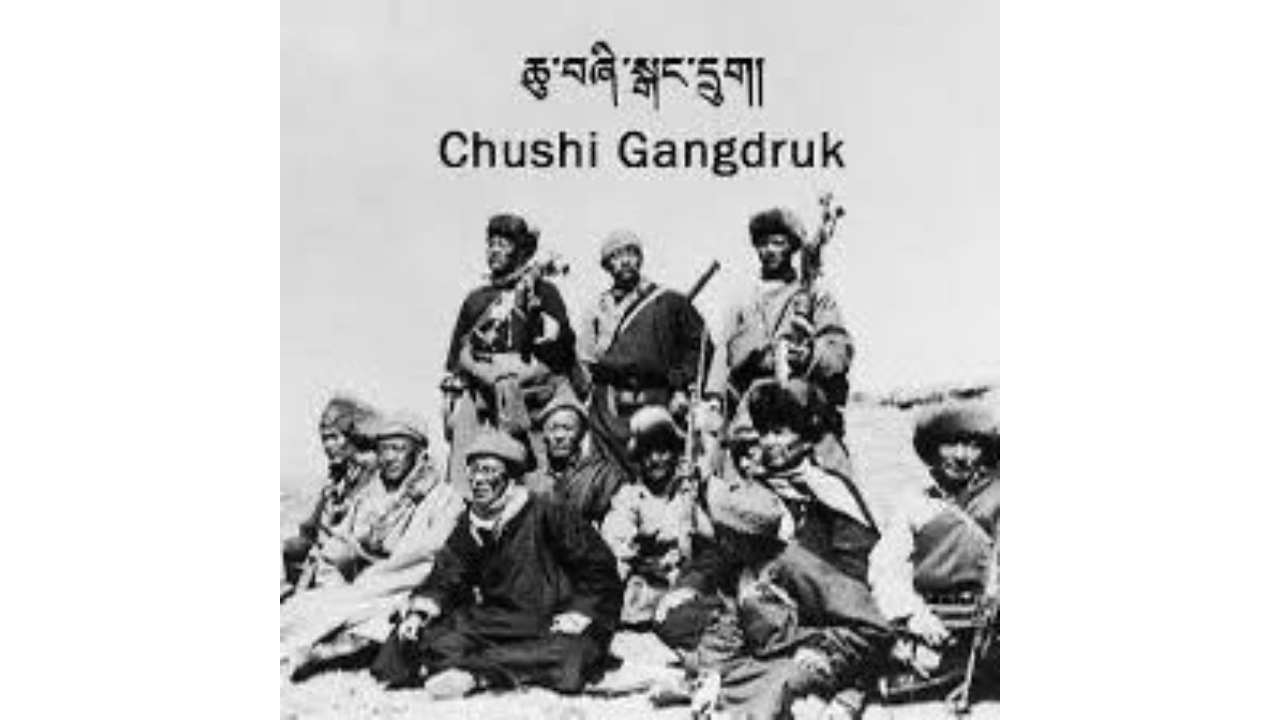
Chushi Gangdruk means “Four Rivers and Six Ranges” and named after the geographical region of Kham, Tibet.The opinion piece below was sent to dorjeshugden.com for publication. We accept submissions from the public, please send in your articles to ds@dorjeshugden.com.
Tibet’s most famous guerilla force, the Chushi Gangdruk (Four Rivers and Six Ranges) was founded in the mid-1950s to serve as a guerilla force to protect the Dalai Lama and Tibet from the Chinese People’s Liberation Army (PLA) who had entered the Tibetan plateau. In the years since they entered exile, the Chushi Gangdruk and their feats have taken their place amongst the legends of Tibetan history. Yet, the true story of their origins is one that the Central Tibetan Administration (CTA; Tibetan leadership in Dharamsala) has heavily manipulated and distorted for the purposes of propaganda.
The stage was set for Chushi Gangdruk’s establishment when in 1950, the Tibetan governor of Kham (a province in East Tibet) colluded with the Chinese forces and surrendered the entire region to the PLA. Disappointed by what they viewed as an act of betrayal, a successful and charismatic merchant named Andruk Gompo Tashi and some of his fellow Khampas sought to consult the most famous of oracles, the Panglung Oracle (kuten) who takes trance of enlightened Dharma Protectors such as Setrap Chen, Kache Marpo and also Gyalchen Dorje Shugden.
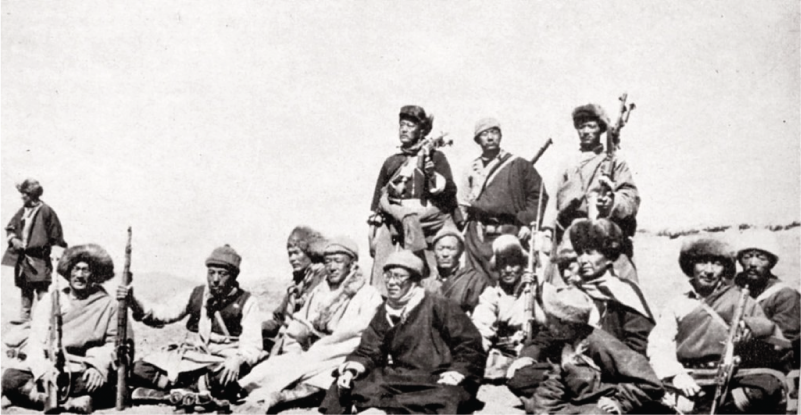
The Chushi Gangdruk was formed as a volunteer militia to protect the Dalai Lama and defend Tibet from the Chinese People’s Liberation Army (PLA). In 1959, it was the Chushi Gangdruk who cleared the way for the Dalai Lama’s safe passage into India with the assistance of the Dharma Protector Gyalchen Dorje Shugden.The Chushi Gangdruk was formed as a volunteer militia to protect the Dalai Lama and defend Tibet from the Chinese People’s Liberation Army (PLA). In 1959, it was the Chushi Gangdruk who cleared the way for the Dalai Lama’s safe passage into India with the assistance of the Dharma Protector Gyalchen Dorje Shugden.
While in trance, Dorje Shugden instructed the group to band together and establish a militia. Their encampment, which came to be known as Lokha-Chaksta Drikung Thang, was located at Pangong Tso, a lake bordering India in Southwest Tibet, that is in the shape of a ritual chopper (drigug). Dorje Shugden’s instructions came after he had previously given extensive advice and instructions to the Tibetan people on how to save their country from falling completely into the hands of the Chinese. That previous advice however, had fallen on deaf ears.
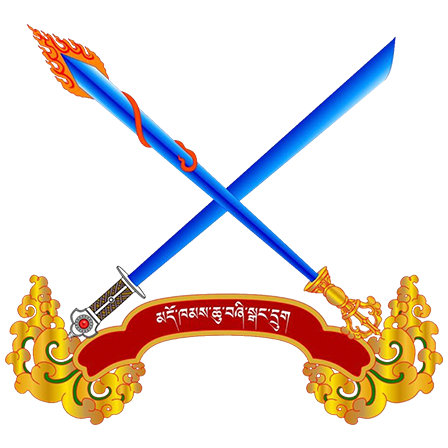
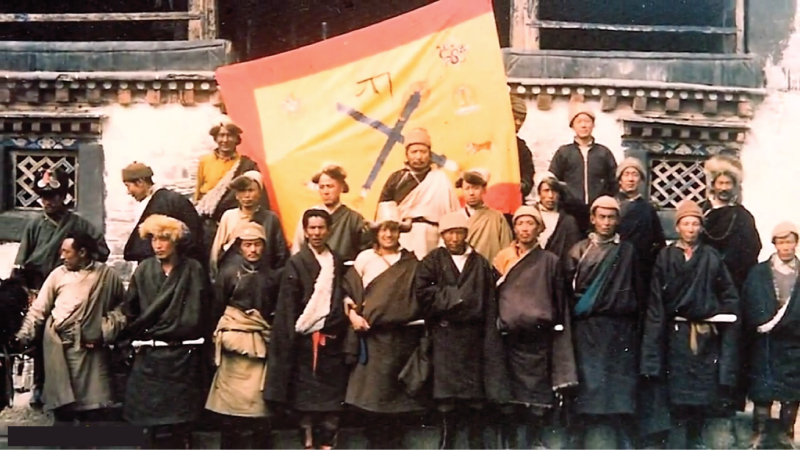
Fortunately, this time Andruk Gompo Tashi and his friends paid heed to Dorje Shugden’s counsel. The militia group named itself the Chushi Gangdruk after their geographical region of Eastern Tibet. They formed their iconic emblem from a pair of crossed swords, a ceremonial sword of the Dharma Protector Dorje Shugden that the Panglung Oracle had given to Andruk Gompo Tashi, and a sword resembling the Wisdom Sword of the Buddha Manjushri that was auspiciously found at the site of their camp at Pangong Tso.
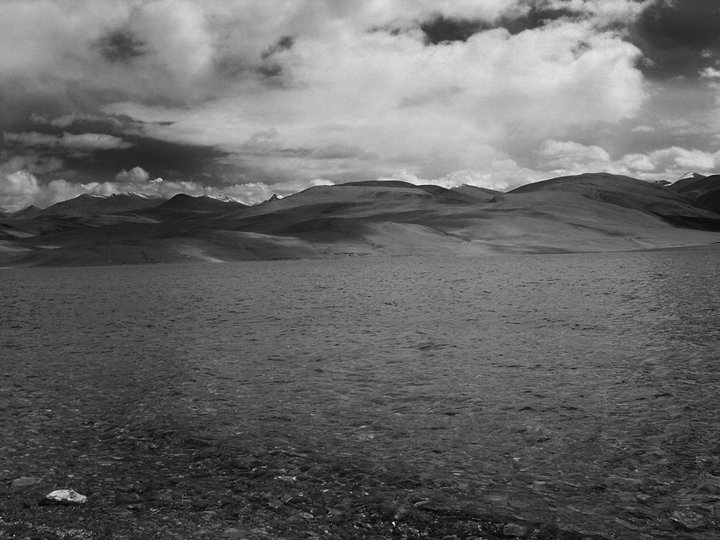
Pangong Tso
The Chushi Gangdruk camp grew as new members were enlisted. Dorje Shugden, acting through the Panglung Oracle, personally instructed many able-bodied men to go to Pangong Tso and join the Chushi Gangdruk. As the numbers of Andruk Gompo Tashi’s small group of resistance fighters swelled, the group grew into a formidable militia and a force to be reckoned with. At their camp, the group trained and waited for instructions, readying themselves for the time they would be called on to play a vital role in the survival of the Tibetan nation, culture and religion.
In 1959 when the Dalai Lama made his famous escape from Tibet, it was members of the Chushi Gangdruk that escorted the Dalai Lama in his historic flight to India. The decision to flee Tibet was also made upon consulting with the Panglung Oracle who, when in trance of the Protector Dorje Shugden, gave precise instructions including the exact route to be taken by the Dalai Lama. This route would through the Pangong Tso area which the Chinese army had learned to avoid, thanks to reports they had received about a fierce guerilla resistance group which was based there. It was not a coincidence that the location Dorje Shugden had chosen for the Chushi Gangdruk to form their base became a strategic point a few years later when the Dalai Lama was forced to escape. A few years before 1959, the protector Dorje Shugden in his perfect clairvoyance already knew the fate that would befall the Tibetan people. Such flawless foresight is only found in Buddhas. Dorje Shugden would also go on to advise the Panglung Oracle to remain in Tibet and to delay his own departure until the Dalai Lama had safely escaped. In this way, Dorje Shugden assured that he would be able to continue assisting and advising people through the Panglung Oracle until the very last minute.
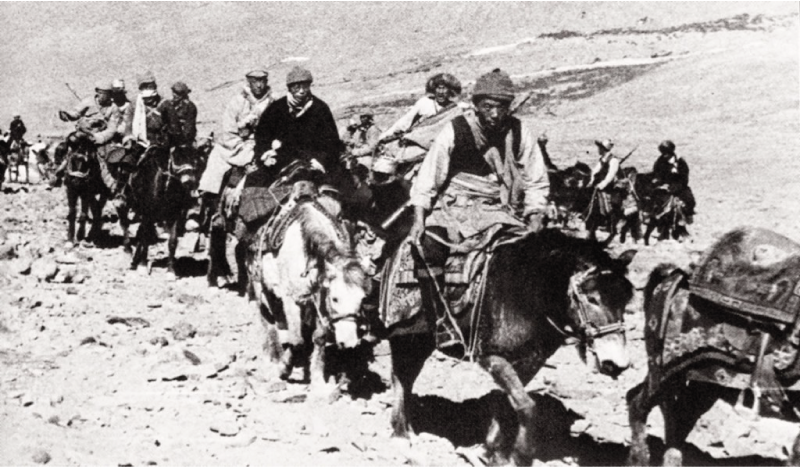
Picture of the Dalai Lama and his armed bodyguards from the Chushi Gangdruk taken in an unknown location in Tibet during the Dalai Lama’s great escape.
Clearing the way for the Dalai Lama
There is no denying the instrumental role that the Chushi Gangdruk played in the escape of the Dalai Lama. The truth of Dorje Shugden’s crucial role in the Dalai Lama’s daring escape has been recorded by many members of the escape party including the changtso of Sera Mey’s Abbot, Losang Yeshe who was present when Dorje Shugden issued the urgent advice for the Dalai Lama to leave Tibet.
In an interview with renowned French-born Tibetologist Claude Arpi, published on rediff.com, Dapon Ratuk Ngawang, one of the senior leaders of the Chushi Gangdruk as well as a close confidant of Andruk Gonpo Tashi, recalls how the group already knew prior to the events from the uprising on March 10, 1959 that the Dalai Lama would not be able to stay on in Lhasa and would have to leave Tibet.
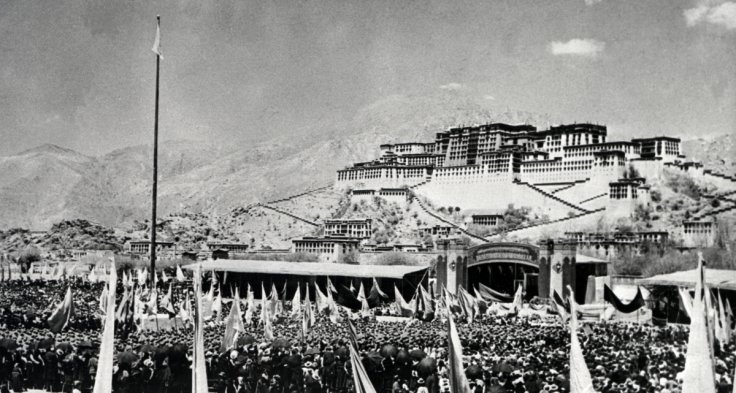
1959 Tibetan Uprising Day
Clearing the way for the Dalai Lama.
There is no denying the instrumental role that the Chushi Gangdruk played in the escape of the Dalai Lama. The truth of Dorje Shugden’s crucial role in the Dalai Lama’s daring escape has been recorded by many members of the escape party including the changtso of Sera Mey’s Abbot, Losang Yeshe who was present when Dorje Shugden issued the urgent advice for the Dalai Lama to leave Tibet.
1959 Tibetan Uprising Day
“[Our work was to] clear the escape route for His Holiness in Lhoka region [south of Lhasa] by making sure that not even a single Chinese soldier remained on that route. This, we did, by either killing or catching Chinese soldiers along the way. That was in March 1959. Before reaching Lhoka region, all the Chushi-Gangdruk volunteers were scattered in all the four directions. We sent many volunteers along the route from Lhoka to areas near Lhasa to clear the way for His Holiness and to make sure that the Chinese authorities could not capture His Holiness. [We already knew that] His Holiness might not be able to stay in Lhasa, but it was the responsibility of the Tibetan government to ensure that he was safe from the [actions] of the Chinese authorities. We were waiting and fighting in the meantime. On 17 March 1959, His Holiness left Lhasa by foot.”
Ratuk Ngawang, who played a key role in the Dalai Lama’s escape to India, later commanded the Tibetan secret regiment known as the Special Frontier Forces, which was based in Uttar Pradesh, India. The accounts in the interview were also written in his memoirs (published in Tibetan by Amnye Machen Insitute, Dharamsala) where he recounts his early life in the Kham province of Eastern Tibet and details of the famous escape to India with the Dalai Lama.
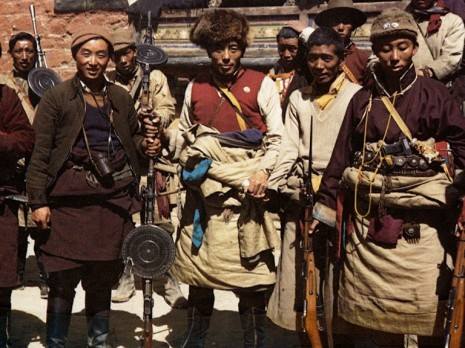
Ratuk Ngawang (middle)
Heroes of the Tibetan cause
It is precisely due to accounts like this that the Chushi Gangdruk is remembered for their acts of heroism and bravery in the face of impossible odds. Yet, the fact the Chushi Gangdruk even had the opportunity to protect the Dalai Lama is solely attributed to the timely and insistent advice Dorje Shugden gave for them to be established and to train. This advice was delivered through the famed Panglung Oracle who, until he received confirmation of the Dalai Lama’s safe arrival in India, delayed his own departure and remained in Tibet so that Dorje Shugden could continue to speak through him to all who required help. Through the oracle, many lamas and monks made their safe passage to India with support from the Chushi Gangdruk.
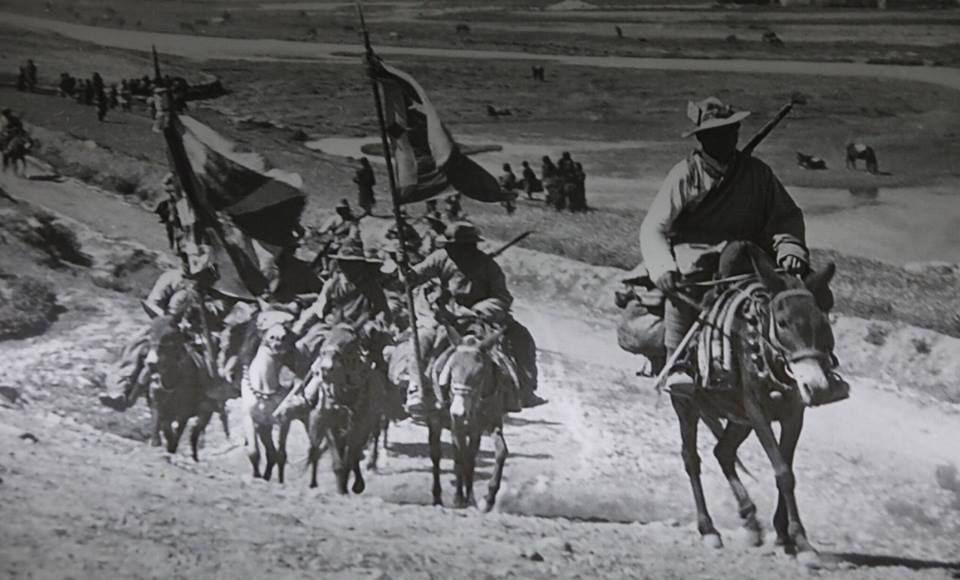
As the only organised resistance movement inside Tibet, the Chushi Gangdruk played an instrumental role in protecting Tibetans’ escape and leading insurgencies against PLA military forces. Even after the Dalai Lama had left Tibet, they continued with their resistance movement. Together with Indian military commandos, the Chushi Gangdruk established a new base in Mustang, Nepal. Called “Establishment 22”, the combined group of Chushi Gangdruk and Indian army commandos, trained by the CIA, waged a guerrilla war against the PLA for 13 years.
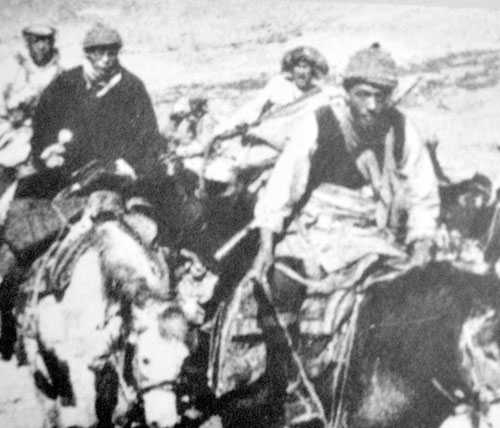
Chushi Gangdruk
When the US and China agreed to a reconciliation policy in 1969, all support and assistance for the Chushi Gangdruk and Establishment 22 was revoked. By 1974, the armed forces of the Chushi Gangdruk was entirely disbanded.
The fall of the Chushi Gangdruk
Members of the Chushi Gangdruk, now in retirement, continued to play an essential part in the Tibetan community-in-exile. The group took on a new role as representatives of the Khampas and Tibetans from the Eastern regions, and established headquarters in Majnu-Ka-Tilla, the Tibetan settlement in New Delhi, India. Chushi Gangdruk members took up key positions in the Tibetan government-in-exile, now known as the Central Tibetan Administration (CTA).
The unity they had fought with however, was not to last in exile and it was not long before disharmony and discord set in. In 1994, some heads of the Chushi Gangdruk signed an accord with the Mongolian and Tibetan Affairs Commission (MTAC) in Taiwan, agreeing to the Kuomintang Party’s One-China Principle, acknowledging that Taiwan and Tibet were part of the People’s Republic of China. This was perhaps due to frustration that had built up in members of the Chushi Gangdruk, having witnessed the stagnation of the Tibetan cause and their leadership fail the people with one broken promise after another.
The Chushi Gangdruk accord with the MTAC angered the Dalai Lama whose view was that the signing had challenged the CTA’s authority. The CTA responded by forbidding all Tibetans from contact with the MTAC and the dismissal of the Chushi Gangdruk heads who had signed the accord, replacing them with new executive members. It is well-known amongst the Tibetan people that to disagree with the Dalai Lama and the CTA is tantamount to suicide even though the CTA claims to be a democracy. No matter how badly the CTA fails their people, the Tibetans are not allowed to express disappointment and to take steps to improve their own future. To do so would imply the CTA is not doing their job, and therefore be regarded as treason and disloyalty.
Ironically, whilst the Chushi Gangdruk who signed the accord were labeled traitors, in essence, the Dalai Lama had already agreed to the One China Policy when he gave up the fight for independence in Strasbourg, France in 1988. It was noted in a Phayul.com article titled ‘Has MTAC turned over a new leaf?’ written by Luke Ward, who wrote that “whilst this accord bears obvious similarities to the Middle-Way Approach of the Dalai Lama and the Central Tibetan Administration, many Tibetans were irked by the fact that MTAC believed itself within its rights to sign an accord, furthermore with an organization that is not a part of the government, and does not represent the Dalai Lama. The resulting controversy split Chushi Gangdruk.”
Having forsaken their illustrious legacy in exchange for political favours, members of Chushi Gangdruk are left in a lurch and at the mercy of the Central Tibetan Administration (CTA). Click to enlarge.
The actions of the CTA caused a rift and resulted in the split of the Chushi Gangdruk. That may have been the CTA’s intention all along, seeing that the Chushi Gangdruk was the brainchild of Dorje Shugden. By 1994, there were already murmurings that the Tibetan leadership was opposed to the worship of Dorje Shugden because it represented the supremacy of the old Gelug spiritual guard which the Tibetan leadership needed to break in order to assume full control over the Tibetan people. The new group, with its CTA-elected heads, formed the Dhotoe Cholka Welfare Society with its headquarters in McLeod Ganj, the town in Dharamsala, India where the Dalai Lama has his official residence and where the CTA is headquartered.
Meanwhile, the dejected members of the original Chushi Gangdruk in New Delhi reformed themselves to become the Dokham Chushi Gangdruk. Both the Chushi Gangdruk groups vie for the position as the Khampa representative in the Tibetan parliament-in-exile.
Following the CTA’s witch-hunts of Dorje Shugden practitioners that formally began in 1996, and Dalai Lama’s now infamous declaration to outlaw the Dorje Shugden practice in 2008, the heads of the Delhi-based Dokham Chushi Gangdruk removed members who chose to continue their Dorje Shugden practice. The group also vowed to disassociate with anyone who continued with the outlawed Protector practice “for the happiness of” the Dalai Lama.
In this way, the original group based in Delhi, once seen as traitors for signing the agreement to recognise the Kuomintang’s One-China policy, have once again became the darlings of the CTA for their vow to disassociate themselves with Dorje Shugden.
Meanwhile, the Dharamsala-based Chushi Gangdruk group created by the CTA has been sectioned by the very same people who established them. The CTA’s ploy to divide and conquer this fierce group of fighters whom they knew had the potential to oppose their misdeeds, had worked.
Chushi Gangdruk, another victim of the CTA’s divisive policies
In the muddled waters of Tibetan exile politics, the position of being either pro-Tibetan or anti-Tibetan is very loose and fluid in nature. Where it was once clear which group was the ‘official’ Chushi Gangdruk and representative of the Kham people, today, that position is an ambiguous mess as both the Delhi and Dharamsala groups compete for recognition and the entitlements for their members.
By disassociating with Gyalchen Dorje Shugden, the Chushi Gandruk today have forgotten their roots and the very reason for their founding. Image from ‘Arrested Histories: Tibet, the CIA, and Memories of a Forgotten War’ written by Carole McGranahan, published by Duke University Press, 2010. Click to enlarge.
Putting the CTA aside, both Chushi Gangdruk groups are in essence, illegitimate and very far removed from their origins. Since both groups have uncoupled themselves with Dorje Shugden, whatever claims they have to be Chushi Gangdruk are rendered void. A Chushi Gangdruk group can only be regarded as legitimate by means of legacy, and if the present groups do not recognise their origins in Dorje Shugden, then those groups are without any official roots. So, how can they declare themselves to be the “official” Chushi Gangdruk?
Formed especially by Dorje Shugden to protect the Dalai Lama and the Tibetan people, the Chushi Gangdruk have themselves fallen to the deceptive web of lies weaved by the CTA about Dorje Shugden being a demon spirit who harms the life of the Dalai Lama. They, of all people, should remember that it was Dorje Shugden who saved the Dalai Lama’s life. And they, of all people, are best positioned to legitimately and strongly refute the CTA’s false accusation that Dorje Shugden can harm the Dalai Lama. By their choice to forsake their patron deity for favor with the Dalai Lama and the CTA, both Chushi Gangdruk groups have in truth, chosen the material rewards of political alignment. The choice to disregard the purpose of their being is another reason why neither of the Chushi Gangdruk groups is legitimate.
Chushi Gangdruk commemorating its 60th Founding Anniversary at Lhagyalri in Dharamshala, India.
It is apparent that the dispute between the Chushi Gangdruk is another situation of Tibetan in-fighting thanks to the CTA’s divisive policies. Dividing brother against brother is a common CTA tactic that recurs regularly – the CTA’s ban of the Dorje Shugden practice and their interference the recognition of the 17th Karmapa have caused two significant monastic orders in Tibetan Buddhism to fall into disarray, just so that the CTA can increase their hold on Tibetans-in-exile. Not content at dividing the community on religious lines, the CTA further divides the exile community along divergent political aspirations; that is to say, rangzen (total independence) versus umaylam (meaningful autonomy). Whilst officially the CTA advocates umaylam, in a more subtle fashion the CTA supports rangzen advocates, with members of the Tibetan leadership attending rangzen camps and conferences held to discuss and organize the movement for full independence. Their actions being so discordant with their official policies have, as a result, led two camps of the Tibetan diaspora into what has oftentimes been a violent clash of political ideology.
Using monetary entitlements such as pensions and allowances, the CTA’s money politics has found another victim in the Chushi Gangdruk. Instead of being the shield that defends the Tibetan people’s unity, by allowing itself to be intoxicated by the miasma that is exhaled from the CTA machinations, it has become part of the wedge the CTA drives into the Tibetan community. Today, the Chushi Gangdruk is no longer heroes of the Tibetan people and defenders of the Tibetan cause. It would not matter which Chushi Gangdruk is regarded as the official one, it is only a hollow tree barren of its ability to bear fruit. History will record that the Tibetans lost their country to China, but Tibet lost its soul at the altar of the CTA’s political agendas.