Abstract
This paper reflects on the complex political dynamics between the United States, the Chinese Nationalist Party (Kuomintang) and Tibetan leaders from 1950 to 1960. In contrast to the existing literature, this study assesses these trilateral relationships by focusing on attempted covert operations and consequences. While volumes of studies have been published about the United States Central Intelligence Agency’s (CIA) involvement in the Tibetan resistance movement, what remains understudied is the secret but unsuccessful attempts at cooperation between the Kuomintang and Tibetans and the role that the U.S. played in these activities. Findings demonstrate that the U.S. and Kuomintang’s interest was driven by the desire to exploit the Tibetan resistance to advance their interests in combating Communist China. However, Tibetan resentment towards the Chinese and the lack of Kuomintang influences in Tibet compelled the U.S. to push back the Kuomintang in these trilateral relationships. This created a major barrier in U.S.-Taiwan relations and between Tibetans and the Kuomintang. In the race to exploit the Tibetan resistance, the U.S. became the winner. The Kuomintang, however, continued to explore the opportunity. Intricacies of nationalism, opportunism and pragmatism transiting through this period reveal realities of realpolitik.
Keywords:
I. Background
In 1949, the Communist Party of China (CPC) achieved victory over its rivals, the Chinese Nationalist Party, known as the Kuomintang (KMT). It forced the KMT leaders and government to escape to Taiwan. Subsequently, the CPC declared the establishment of a new government, the People’s Republic of China (PRC). The new government in China declared that the People’s Liberation Army (PLA) was then to “liberate Tibet”, meaning the incorporation of Tibet as a part of the PRC.Footnote1 At this time, Tibet consisted of three regions: U-Tsang, Kham and Amdo. (Tibetans from Kham are called Khampa, Tibetans from Amdo are called Amdowa and Tibetans from U-Tsang are called U-Tsangpa.) The three shared strong ethnic, cultural and religious affinities but the central Tibetan government in Lhasa only had direct control over U-Tsang and some parts of Kham. Amdo and other parts of Kham were autonomous. This status would later allow their leaders to establish different relations and alliances to those of the central government.
The PLA made its first attack on Kham at a place named Dengo, situated fifty miles from Chamdo, the headquarters of the Tibetan army’s eastern command. On September 9, 1951, more than 3,000 PLA soldiers attacked and captured Chamdo, the first phase of a steady expansion into other eastern parts of Tibet. From 1954 to 1956, the PLA invasion reached Kham’s major centres, including Bathang and Lithang, and imposed “democratic reforms” in these areas. The imposition of these so-called reforms entailed various forceful transformations and attacks on monasteries that constituted the heart of Tibetan society.Footnote2 The violence and associated atrocities triggered discontent and then open resentment, leading to the full-fledged Khampa rebellion.Footnote3 The first major revolt, beginning in 1954, was the Kanting Rebellion, which involved approximately 40,000 partisans.Footnote4 In 1956, the Lithang Rebellion involved more than 15,000 Khampas resisting a fierce PLA attack in which their monastery was bombed.Footnote5 These two major revolts, plus other smaller actions, sent a clear message that most of the Tibetan population in the eastern region was willing to fight against the Chinese forces.
Eventually, these revolts led to the formation of a grassroots Tibetan voluntary resistance army, called Danglang Tensung Makhar (the Voluntary Resistance Army to Defend Buddhism). Gonpo Tashi AndrugtsangFootnote6, a famous merchant chief from Kham-LithangFootnote7, was the group’s founder and the leader. As the resistance movement expanded, he reorganized the Voluntary Resistance Army and, in 1958, it was formally named Chushi Gangdruk (Four Rivers Six Ranges (FRSR)), an ancient term for eastern Tibet.Footnote8 By the end of 1958, Chushi Gangdruk had eighteen military commanders and forty leaders with about 5,000 volunteer troops.Footnote9 In Lhasa, the capital, another resistance group, called Mimang Tsongdu (People’s Assembly), was formed under the leadership of another famous trader from Kham named Alo Chonzed Tsering Dorjee. Miming Tsongu started circulating pamphlets that denounced the infiltration of PLA into Tibetan areas and the imposition of that forceful transformation.Footnote10
While the Tibetan voluntary resistance armies were taking up arms to resist the Chinese invasion, they also knew that they lacked both the personnel and the military capability to resist the PLA. They therefore saw it as imperative to seek military help from other countries. In 1956, Gonpo Tashi Andrugstang sent a group of twenty-four resistance fighters from Lithang to India to seek the help of India and the United States.Footnote11 During this visit to India, they also met with a local representative of the Kuomintang.
Several booksFootnote12 have been published about the trilateral relationship between the Tibetan leadership, the United States and the Kuomintang during this particular period. However, there are two limitations of the existing literature. Firstly, the focus of these books is on U.S.-Tibet relations and, as a result, highlights only the contacts made between the Kuomintang and the second elder brother of the Dalai Lama, Gyalo Thondup, and the Chushi Gangdruk army. We lack a nuanced study about those contacts, why they failed to yield any positive results and what the episode tells us about these relationships. Secondly, some of the accounts presented in these books, such as those by John Garver are taken from Michel Peissel and are inaccurate.
This study aims to provide a more nuanced analysis of the trilateral relationship between the U.S., the Kuomintang and Tibetans from 1950 to 1960. Instead of covering all aspects, including political and diplomatic interactions, it emphasizes the various attempted covert operations in Tibet organized between the U.S. and the Kuomintang in Tibet and between the Kuomintang and Tibetans. The study also illustrates the consequences of those joint operations. With this new approach, the paper aims to provide different perspectives. The analyses presented in this study are drawn from various sources of data, including the archives of the U.S. State Department, and secondary scholarship and interviews with Tibetans in Taiwan. This study has the particular advantage of an interview given by the last survivor of the 32 Tibetan paratroopers trained by the Kuomintang in the late 1950s.
II. Resist communism: the first phase of complex trilateral relations (1951–1958)
II.1. The Kuomintang and Tibetans
Gyalo Thondup was the first Tibetan to establish initial contact between the Kuomintang in Taiwan and Tibetans in exile. From 1942–1949, until the defeat of Kuomintang in China, he attended the Kuomintang-run Central University of Politics in Nanjing and already had a close relationship with Chiang Kai-shek. His wife, Zhu Dan, was the daughter of one of the leading Kuomintang generals, Zhu Shi-gui.Footnote13 When the PLA started the military intrusion at Kham, he and his wife were in India. After hearing the news about the Chinese military intrusion, he planned to return to Tibet. Therefore, in May 1950, Gyalo Thondup reached Manila and from there he and his wife planned to travel to Macau and then to China and Tibet. However, the Portuguese authorities in Macau denied their visa, leaving him trapped in Manila. Immediately after hearing the news, Chiang Kai-shek approached him in Manila and invited him to Taiwan.Footnote14 The Kuomintang pursued his visit as an important opportunity to establish relations with Tibetans in exile and potentially collaborate against the PRC.Footnote15 Gyalo Thondup not only received a warm reception during his visit, but Chiang Kai-shek and the other Kuomintang officials he met advised him to be vigilant of the CPC.Footnote16
The couple were supposed to leave for the United States to join Gyalo Thondup’s elder brother Taktse Rinpoche, who was already there to seek international support for the Tibetan resistance. However, after Chiang Kai-shek discovered contact between Gyalo Thondup and Zhu De, the PLA Minister of Defence, Kuomintang detained him for a few months.Footnote17 It was only following intervention from the United States that he was allowed to leave Taiwan, a few months later in July 1951. This first visit failed to generate any cooperation between Tibetans and the Kuomintang.
In 1952, Chiang Kai-shek received a secret proposal from a group of Tibetans which mentioned that several influential leaders from the Tibetan regions of Kham and Amdo shared his resentment towards Communist China and were ready to cooperate with the Kuomintang to launch a guerrilla war.Footnote18 These leaders included Lobsang Tsewang (Chinese name: Huang Zheng-qing), an important leader of Labrang monastery in southern Gansu who was also a member of the Central Committee of the Kuomintang; Su Yong-he (Tibetan name: Dorje Palsang)Footnote19, one of the chieftains from Nagqu and Ma Yuan-xiang, a Muslim from Qinghai.Footnote20 At the same time, Chiang Kai-shek also received a letter from Gyalo Thondup requesting the Kuomintang’s military assistance.Footnote21 Chiang Kai-shek responded to Gyalo’s proposal first and agreed to help. However, according to Gyalo Thondup:
Chiang Kai-shek was ready to provide both arms and monetary help, but the Tibet Cause and the goal of the Nationalist government were not the same. We wanted Chiang Kai-shek’s support for a free and independent Tibet so the removal of Communist China was the only means to achieve the goal. Whereas the Nationalist government in Taiwan wanted us to fight to overthrow the Communists to restore their government in China. We could not accept their terms. Furthermore, Communist China was already putting propaganda that we were tools of the Nationalist government. Therefore, we never refused the Nationalist government offer outright but we simply did not respond.Footnote22
From 1952 to 1956, except for these limited conversations, no major cooperation was undertaken directly between the Tibetans in exile and the Kuomintang. This was even though Tibetan rebels in Amdo continued to receive airdrops from Taiwan. This was because there was already cooperation between the U.S. and the Kuomintang in training Kuomintang guerrilla forces and airdropping them into regions bordering Tibet such as Qinghai and Sichuan. According to Conboy and MorrisonFootnote23, the United States was running a two-track covert operation to assist Chinese guerrilla forces against the CPC. One was in cooperation with the KuomintangFootnote24 while the other provided training for anti-communist Chinese (the Third Forces) who were not affiliated with the Kuomintang. Tibetan rebels from Amdo also received airdropped supplies from Nationalist planes flying over Amdo.Footnote25 At this time, there were an estimated 80,000 rebels in Amdo, including the nationalist forces of Ma Bao-feng and Ma Feng-Kwei. One of the Tibetan rebel leaders from Amdo named Gompo Sham recalled that they were fairly well-equipped for the time being because of the supply from the Kuomintang in Taiwan.Footnote26 It is not clear whether these airdropped supplies resulted from the 1952 secret letter received from a few Tibetan rebels, but the fact is airdrops provided a great deal of help for a short period.
The outbreak of the Lithang Rebellion in 1956 prompted the U.S. to reconsider its interest in Tibet and had a similar effect on the Kuomintang. Chiang Ching-kuo, the son of Chiang Kai-shek, who was in charge of the Intelligence Bureau and security apparatus of the Kuomintang in Taiwan, saw the growing situation in Kham as an opportunity. He therefore saw a reason to provide the Khampa rebels with much-needed supplies and weapons. The Kuomintang then developed a new plan to airdrop more arms, along with well-equipped Kuomintang-trained agents, in Tibetan areas.Footnote27 The planning was at the top of Chiang Ching-kuo’s agenda of anti-communist missions. As part of this plan, the Kuomintang tried to contact various Tibetan resistance leaders. Chiang Kai-shek sent a Tibetan Muslim from Qinghai named Tsepak DorjeeFootnote28 (Chinese name: Cai Ding-zhong) to India to meet the now-exiled, Dalai Lama. Accompanying him were Wang Qing-fang, the director of the Liaison Office of the National Security Bureau, and Cheng Yi-ming, the director of the Macau Station of the Intelligence Bureau of the Ministry of National Defense.Footnote29 It is not clear whether they met the Dalai Lama, but they did meet a representative of the Tibetan voluntary resistance army in Kalimpong, a hill town in the Indian state of West Bengal.Footnote30
Tsepak Dorje later played an instrumental role in recruiting Tibetans to Taiwan. He worked with the Intelligence Bureau of the Kuomintang. His mission in India was to persuade more exiled Tibetans to join the Kuomintang anti-communist mission and advocate for Tibet’s autonomy within non-communist China.Footnote31 His meeting with the representative of the Tibetan voluntary resistance army in Kalimpong was, however, unsuccessful. At the time, Gyalo Thondup was already in touch with the CIA about a plan to send the first batch of fighters from the Tibetan resistance army to the U.S. for training. Representatives informed Gyalo about their meeting with the Kuomintang agent and, in response, Gyalo Thondup informed them that Taiwan could not be much help as it had already lost the war with the CPC. He further stated that even if the Kuomintang had agreed to help the Tibetans, it would eventually have to go to the U.S. for help itself, therefore the Tibetan resistance should directly approach the U.S. to gain its support.Footnote32 Gyalo justified his rejection of cooperation with the Kuomintang because such an agreement would affirm the CPC allegation that there were alliances between the two “reactionary groups”.Footnote33 Such collaboration could do more harm to the Tibetan resistance movement than help it. By this time, Gyalo Thondup had also decided to stop the communication channel with Taipei.Footnote34
According to Michel Peissel and Goerge Patterson, several other prominent Tibetan resistance leaders such as Rapga PandatsangFootnote35 and Gonpo Sham also visited India to seek U.S. help and the U.S. in turn asked them to seek aid from Taiwan.Footnote36 However, there is no record to confirm whether they did so.
II.2. The U.S. and Tibetans
The United States’ interest in Tibet was shaped during the Second World War. In 1942, two officers from the Office of the Strategic Services (OSS) were sent to meet Lieutenant General Joseph W. Stilwell in China. On that occasion, they also met the Dalai Lama, who was both spiritual and temporal head of the Tibetan government in Lhasa. This was the first official contact and the beginning of a new trilateral relationship between the U.S., Tibet and the Kuomintang. When the Tibetan side asked for three long-range radio transmitters for broadcasting purposes, the American side refused, fearing that such an act might anger the Chinese Nationalists. However, the Americans eventually accepted the request after considering its future strategic value.Footnote37 In 1949, when the PRC made its declaration about the future incorporation of Tibet, the Truman administration chose to remain silent. However, the Korean War in 1950 and the CPC’s intervention in the war by supporting North Korea reinforced the U.S. determination to confront communism in Asia. They not only renewed contacts with the Chinese nationalists in Taiwan but also began to show more interest in helping Tibet as a means to contain CPC influence.Footnote38 Subsequently, on 17th September 1951, Loy W. Henderson, American ambassador to India, sent an unsigned letter to the Dalai Lama. The letter stated that the U.S. government was prepared to support Tibetan resistance to the Chinese invasion. It further stated that, as long as mutually satisfactory purposes were being served, the US pledged to provide financial support to the Dalai Lama, his family and a retinue of about 100 persons.Footnote39 Subsequently, the CIA helped the Dalai Lama’s eldest brother, Thubten Norbu, to escape from Tibet to the U.S.Footnote40
Before 1956, U.S. contact with Tibetans was limited to isolated expressions of assistance. In other words, they were not keen to take any drastic action, either politically or militarily, nor was there going to be any statement from the U.S. concerning the PLA intrusion into Tibet. The reasons why the U.S. chose to remain low-key was a combination of three factors—India, Taiwan and Beijing. India, guided by an ambition to establish a friendly neighbourly relationship with China, was the first country to recognize the PRC and also affirmed Tibet as part of China in 1954. Consequently, India was cautious not to take any actions that might hamper its foreign policy interests. The U.S. feared that any overt actions it took concerning Tibet might suggest to Nehru that it had instigated the revolt in Tibet and that this could prompt an Indian reaction against both the Tibetans and the U.S.Footnote41 Regarding Taiwan, the U.S. followed a policy which stated that, as long as Tibet was regarded as autonomous, the United States recognized Chinese suzerainty over it. Even though it had never formally recognised Chinese sovereignty over Tibet, the U.S. was careful not to harm the legitimacy of the Republic of China (ROC) which was facing a significant challenge from the PRC.Footnote42 The U.S. also feared that any overt action taken by the U.S. in Tibet might provoke a more volatile reaction from Beijing in suppressing Tibetan resistance. However, American attitudes changed after 1956, because of the series of revolts in Kham and Amdo and the formalization of the Tibetan voluntary resistance army. They encouraged the U.S. to take a more active role which resulted in the CIA’s covert operation in Tibet.
II.3. The U.S. and Kuomintang joint operation in Tibet
The Kuomintang’s attempts to work with the Tibetans remained unsuccessful. However, encouraged by the crisis created by Mao’s ‘Great Leap Forward’ in 1958 and the formalization of the Tibetan voluntary resistance army, Chiang Kai-shek pushed for more support and joint actions in Tibet. The Kuomintang proposed to the U.S. a joint operation in Tibet with the plan to recruit seventeen Khampas as the first step toward a larger anti-communist mission.Footnote43 After much pushing from Chiang Kai-shek, the CIA agreed to joint action in February 1959.Footnote44 According to Conboy and Morrison (2002, p.103), Operation ST Whale was launched largely involving Hui Muslims and was confined to the Amdo region.Footnote45 The operation failed since the agents were quickly captured by the PLA. The operation was quietly shelved.Footnote46 In this first phase, there was no action taken between Tibetans and the Kuomintang.
III. The 1959 Tibetan national uprising and a new twist: the second phase of relations
The revolts in Kham and Amdo met with intense military reactions from the PLA and, as a result, more refugees from these two regions entered Central Tibet and Lhasa. The chaos and increased antagonism towards the PLA incursion triggered the 1959 Tibetan national uprising in Lhasa, which gained international media attention.Footnote47 The uprising raised hopes in the Kuomintang that it could trigger revolt all over China and overthrow the CPC. Allen Dulles, director of the CIA, reported that Chiang Kai-shek was anxious to do something to continue the revolt.Footnote48 During this period, the Kuomintang policy toward Tibet operated at two levels: strategic and political. Strategically Tibet’s resistance against the PRC was perceived as an important avenue to overthrow the CPC and re-establish a Kuomintang government. Moreover, action to support the Tibetan resistance was also crucial to boost the morale of the defeated Kuomintang supporters in Taiwan. Politically, however, they maintained the state policy that regarded Tibet as part of the ROC. In opposition to Tibetans, therefore, the Kuomintang saw this conflict as not being anti-China but anti-communist. This major difference in the status of Tibet and the end goal of combatting the PRC posed a key challenge in promoting bilateral relations between Tibetans in exile and the Kuomintang and also between the U.S., Taiwan, and Tibetans in exile.
On March 26, 1959, Chiang Kai-shek issued a “letter to Tibetan compatriots”, originally written in Chinese although an English version was published by Taiwan Today, an official publication of the ROC’s Ministry of External Affairs. The text of the letter can be summarized as:
Tibetan compatriots!
This time you rose to resist the Communist violence and fought bloody battles. This is the beginning of the most solemn and glorious history of the anti-Communist revolution for all our compatriots in mainland China. Although I am in Taiwan today, my heart is always with you to fight against communism. Especially in this war in Lhasa, made me care even more deeply and will never be forgotten. The government of the Republic of China is concentrating all its efforts to provide you with continued and effective assistance. You are not alone. Your anti-communist and violent movement not only demonstrates your fearless spirit for the survival of Tibetans but also plays an incomparable heroic role in the freedom and security of all ethnic groups and religions in Free Asia. The government of the Republic of China has always respected Tibet’s inherently political and social organizations and guaranteed the Tibetan people’s freedom of religious belief and traditional life.
I now declare even more solemnly that: Tibet’s future political system and political status will depend on the principle of self-determination of our nation and the realization of your wishes once the bandit and puppet regime is destroyed and the Tibetan people can freely express their will.Footnote49
With the letter, Chiang Kai-shek intended to achieve two goals. The first was to show his support for the revolts, and the second was to reassert Kuomintang’s authority over Tibet and Tibetan affairs. In Taiwan, Chiang Kai-shek also launched a big rally that called for people from all walks of life to support the Tibetan compatriots’ fight against the CPC.Footnote50
Chiang Kai-shek also reached out to the U.S. once again for a joint operation arguing that the success of this operation might be a prelude to his dream of mainland recovery.Footnote51 The U.S. turned down the proposal and informed Taipei that it had already launched an operation with Tibetans in Tibet without Taipei’s involvement.Footnote52 As much as Chiang Kai-shek and the Kuomintang were desperate to take advantage of the revolts in Tibet, neither the Chushi Gangdruk army nor the U.S. responded positively to their offer of cooperation, much to their disappointment. What prompted the U.S. to turn down the cooperation? The United States Information Agency Director, George V. Allen, while discussing the uprising and revolts in Tibet stated that:
The Tibetan revolt was not so much anti-communist in characteristic as it was anti-Chinese. The Tibetans would probably dislike the Chinese Nationalist government as much as they disliked the government in Peiping. Accordingly, we should try to tone down Chiang Kai-shek’s over-eager exploitation efforts.Footnote53
The U.S. ambassador to Taipei, Everett Francis Drumright, while recommending to the Department of State a programme of increased support for the Tibetan resistance army, also advised against any joint activities with the Kuomintang in Tibet stating a similar reason. He argued that “Tibetans are antagonists to all Chinese regardless of their political affiliations”.Footnote54 While referring to Chiang’s reaction to the Tibetan uprising, he further stated that as much as Chiang was anxious to do something to encourage the continuation of the Tibetan uprising, he did not have much influence in Tibet because he consistently opposed Tibetan independence.Footnote55 A document released by the CIA during the same period, titled “Resistance in Tibet” also highlighted the Tibetan antagonism towards pan-Han arrogance and the traditional legacy of freedom as the central factor that drove the resistance.Footnote56
Therefore, the problem recognized by U.S. officials was the lack of Kuomintang influence over Tibet and the history of Tibetan resistance towards the Chinese. The U.S. understood that, for Tibetans, this fight was to throw off Chinese control over Tibet and this included Nationalist claims. For the Kuomintang, which considered Tibet a part of China, this fight was not anti-China, but anti-communist. The existential differences about why Tibetans were resisting the Chinese invasion created a barrier not only between Tibetans and the Kuomintang but also between the U.S. and the Kuomintang.
A series of conversations between the Kuomintang and the U.S. concerning Tibet during this period reveals that the U.S. had not only turned down cooperation with the Kuomintang but also that there was a shift in the U.S. attitude towards the Tibet issue. For instance, in November 1959, the U.S. circulated a letter to the governments of the United Kingdom, India and also the ROC stating the U.S. position on the status of Tibet:
It has been the historical position of the United States to consider Tibet as an autonomous country under the suzerainty of China, the American people have also traditionally stood for the principle of self-determination. The United States Government believes that this principle should apply to the people of Tibet and that they should have the determining voice in their political destiny.Footnote57
The American policy on the status of Tibet shifted from accepting Chinese suzerainty over Tibet and affirming support for autonomy to broadening the position by including a statement calling for Tibet to be an “autonomous country” under Chinese suzerainty with a right to self-determination. Furthermore, a series of conversations between George K.C. Yeh, the ROC ambassador to the U.S., and Walter S. Robertson, Assistant Secretary of State for Far Eastern Affairs in April 1959, reveals that the U.S. went further by urging the ROC government to renounce sovereignty over Tibet and recognize Tibet’s independent status.Footnote58
In addition to the change of language about the status of Tibet, the CIA operation (which was initially limited to intelligence collection) was expanded into a long-term programme with the provision of limited arms and training more Tibetan volunteer forces.Footnote59 The U.S. continued the CIA operation with the Tibetan voluntary resistance army, and it stopped further joint operations with the Kuomintang in Tibet. The Tibetan resistance, especially Gyalo Thondup, who was the primary leader of the cooperation with the CIA and also a dear friend of Chiang Kai-shek stopped all communication with the Kuomintang.Footnote60
IV. The Kuomintang goes solo (1960): the hidden story of the Tibetan paratroopers in Taiwan
By late 1959, the Kuomintang was anxious that it was losing opportunities to advance its interests within the Tibetan resistance and that the United States was gaining ever-greater advantages to manipulate the Tibetan cause. Frustrated, Chiang Kai-shek expressed strong displeasure to the U.S. ambassador to China, Everett F. Drumright over the American government’s failure to coordinate operations with the Kuomintang to exploit the uprising. He further went on to argue that “the Tibetan uprising was a Chinese affair in which the Kuomintang must play a role to justify its existence and mission.”Footnote61 Whether the U.S. approved or not, the Kuomintang proposed to undertake guerrilla warfare on the mainland.
In addition to other operations, Chiang Kai-shek decided to go his way and launch a covert operation in Tibetan areas using Tibetans in exile. The Kuomintang’s action was intended to demonstrate that Tibetan affairs were also Chinese internal affairs and that the Kuomintang’s influence among Tibetans remained intact. In other words, these actions also aimed to assert the ROC’s authority over Tibet. In early 1960, the Kuomintang in Taiwan launched a programme to recruit Tibetans and train them as paratroopers for a secret operation in Tibet. This was called the “Chuan, Gan, and Qing Frontier Cadre Training Class”. Chuan means Sichuan, Gan means Gansu, and Qing means Qinghai, and these were targeted areas of the operation.Footnote62 According to ChoNga Tsering (Chinese: Jue An-CeRen),Footnote63 who had recently retired as the head of Tibetan affairs at the Mongolian and Tibetan Culture Center in Taiwan, both Gyalo and the U.S. opposed cooperating with Chiang Kai-shek. The Generalissimo then used his secret agents to recruit Tibetans from India and Nepal and bring them to Taiwan to be trained for a covert operation against the CPC.Footnote64 He sent Tsepak Dorjee and other officers from the Intelligence Bureau back to India for a second time on a mission to recruit Tibetans in exile for the covert operation. Tsepak Dorjee used his ethnic networks to recruit Tibetans in exile for this particular programme. Tsepak Dorjee recruited Tenpa and Lobsang Kyap (Ch: Luosang Gyatha)Footnote65 for this mission because they were from the same native place and they were acquaintances.Footnote66
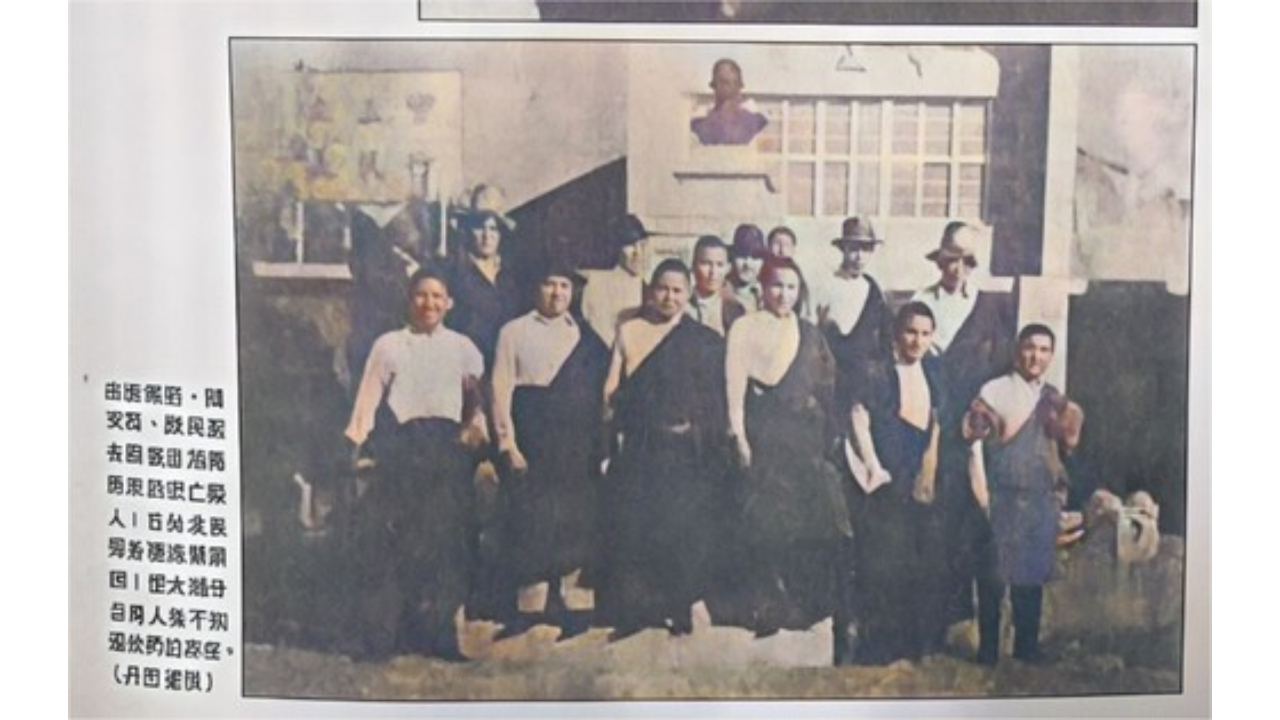
At age 90, Yeshi Tenzin is the last survivor of 32 Tibetans who were recruited as a part of the “Chuan, Gan, and Qing Frontier Cadre Training Class.” He is originally from the Kham-Gyalrong and currently lives with his family in Tianmu in northern Taiwan. In an interview with the author, Yeshi described how, when he was 18 years old, he followed his Tibetan countrymen to India after the PLA attacks intensified in his native homeland. Before going into exile, the participants in the programme were nomads from Kham and Amdo and none of them had any military training. While in exile in Kalimpong (India) looking for jobs, he says someone approached him and asked if he wanted to go to Taiwan.Footnote67 Yeshi further noted that during this period, many secret agents working for the CIA and the Kuomintang would approach Tibetans and ask if they were interested in going to Taiwan or the U.S. A total of 32 Tibetans from India were recruited to this operation in Taiwan.
Michel Peissel provides information about the collaboration between Rapga Pangdatsang and the Kuomintang in the recruitment of these troops. Yeshi, however, denied this version of events, asserting that Rapga Pangdatsang played no role in it. Carole McGranahan, an expert on the Chushi Gandruk and Pangdatsang family, attests that there is no other evidence of Rapga Pangdatsang’s collaboration with the Kuomintang in these matters.Footnote68
Like Yeshi, some of the Tibetans were recruited on the pretext of being given a job, while others were informed about the training. It must be noted that none of the 32 were part of the Chushi Gangdruk army.Footnote69 The recruitment took place based on whoever was willing to take part in the programme (Figures 1 and 2).